🔑 Key Takeaways: How Inflation Impacts Aftermarket Auto Parts Margins
📈 Inflation compresses aftermarket auto parts margins through uneven cost timing
Inflation does not hit all parts of the supply chain at once. Raw materials, labor, logistics, and retail pricing adjust at different speeds. This timing gap creates short-term margin compression for distributors and retailers even when sales remain stable.
🚚 Supply chain and logistics costs amplify inflation pressure on auto parts profitability
Rising fuel prices, warehouse labor costs, and transportation expenses increase the total cost of distribution. These hidden expenses scale across national networks, making logistics one of the biggest drivers of margin erosion in the aftermarket industry.
🏷️ Retailers use pricing lag strategies to protect aftermarket auto parts margins
Auto parts retailers often adjust prices based on expected future costs rather than current ones. This creates a lag effect where prices may rise faster or stay elevated longer than actual costs, helping stabilize or temporarily recover margins during inflation cycles.
🏭 Company size determines how well firms withstand inflation-driven margin pressure
Large aftermarket companies handle inflation better due to scale advantages like bulk purchasing, inventory control, and stronger supplier contracts. Smaller distributors face tighter margins because they lack pricing power and operational flexibility.
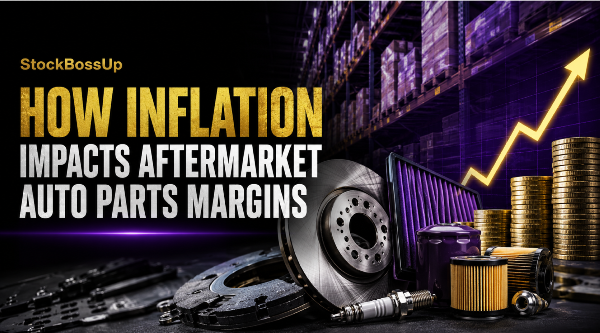
How Inflation Impacts Aftermarket Auto Parts Margins
When inflation rises, most people notice it at the gas pump or grocery store. But a quieter shift happens in the automotive aftermarket. Every replacement part, from brake pads to alternators, is tied to a cost chain that reacts to inflation in uneven ways.
The problem is not just higher prices. It is how uneven cost changes move through the system. Some costs rise instantly. Others lag behind. That gap creates pressure on profit margins that most consumers never see.
The real challenge is timing. Suppliers, distributors, and retailers all adjust at different speeds. That mismatch is where margins are gained or lost.
The solution to understanding this system is not obvious at first—and that is where the real story begins.
Why Do Auto Parts Prices React So Quickly to Inflation?
Auto parts are tightly connected to raw materials. Steel, rubber, copper, aluminum, and plastics all feed directly into production costs.
When inflation rises, these inputs often increase before finished goods pricing adjusts. That creates a short-term squeeze on margins.
Manufacturers pass costs downstream, but not instantly. Retail pricing often updates in cycles, not real time. That delay causes temporary profit compression.
Inflation in this industry rarely moves in a straight line. It moves in waves tied to global supply chains.
| Cost Layer |
Inflation Response Speed |
Who Feels It First |
Margin Impact |
| Raw materials |
Immediate |
Manufacturers |
High |
| Production |
Weeks |
Suppliers |
Medium |
| Distribution |
Delayed |
Wholesalers |
Medium |
| Retail pricing |
Periodic |
Consumers |
Short-term squeeze |
A lesser-known detail is that brake system manufacturers often renegotiate steel alloy contracts multiple times per year because even small shifts in metal pricing can alter production margins significantly.
Why Do Supply Chain Costs Multiply Inflation Pressure?
Even if part prices stay stable for a short time, supply chain costs often rise faster.
Fuel, labor, insurance, and warehouse expenses all increase during inflationary periods. These costs are harder to pass on quickly.
Companies often absorb these increases to avoid losing customers. That delay creates margin compression.
Working capital also becomes more expensive. Inventory costs more to hold, and cash flow slows down.
| Expense Type |
Inflation Sensitivity |
Visibility to Customer |
Margin Pressure |
| Fuel & transport |
High |
Low |
High |
| Warehouse labor |
Medium |
Low |
Medium |
| Inventory financing |
High |
Hidden |
High |
| Facility overhead |
Medium |
Invisible |
Medium |
Over time, these small increases stack up across the entire distribution system.
Why Do Retail Prices Lag Behind Rising Costs?
Retail pricing does not always reflect current costs. It often reflects expected future costs.
Retailers monitor supplier trends and adjust prices before full cost increases arrive. This helps protect margins but can create uneven pricing cycles.
During fast inflation, prices may rise faster than costs. During slowdowns, prices often stay high longer than costs fall.
This creates a buffer effect that helps stabilize earnings.
A notable pattern in high-turnover products like batteries and filters is that some retailers adjust pricing weekly, while others adjust monthly, creating temporary price gaps across regions.
How Do Distribution Networks Amplify Inflation Effects?
Distribution is where inflation becomes multiplied.
Large aftermarket companies rely on centralized warehouses and national logistics networks. Any increase in cost spreads across thousands of shipments.
Fuel prices, trucking costs, and warehouse labor all scale across the system.
Small increases in logistics expenses can become large national cost pressures.
| Distribution Factor |
Inflation Impact |
System Effect |
| Fuel costs |
High volatility |
Nationwide ripple |
| Trucking rates |
High sensitivity |
Delivery cost spikes |
| Warehouse staffing |
Medium |
Regional cost pressure |
| Routing inefficiency |
Medium |
Hidden cost growth |
One overlooked detail is that even minor inefficiencies in delivery routing become significantly more expensive during inflation because fuel and labor costs compound across every stop.
Why Do Labor Costs Matter More Than Expected?
Labor is one of the most consistent inflation drivers in the aftermarket industry.
Warehouse workers, drivers, and retail employees all require wage adjustments during inflationary periods.
Unlike materials, labor costs cannot be quickly reduced. Companies often absorb increases before adjusting prices.
Labor shortages also force companies to offer overtime and incentives, increasing cost per unit sold.
| Labor Segment |
Inflation Response |
Flexibility |
Margin Pressure |
| Warehouse staff |
Wage increases |
Low |
High |
| Delivery drivers |
Fuel + wage pressure |
Medium |
High |
| Retail workers |
Competitive pay |
Medium |
Medium |
| Skilled technicians |
High demand |
Low |
High |
These increases ripple through every stage of distribution.
How Do Raw Materials Flow Into Margin Pressure?
Auto parts depend heavily on commodities.
Steel affects braking systems. Rubber impacts tires and seals. Copper drives electrical components. Plastics depend on oil-based inputs.
When commodity prices rise, the effect moves through the supply chain in stages.
Manufacturers adjust first, followed by distributors and then retailers. Each step introduces delay and margin pressure.
A second unexpected pattern appears in electrical systems: copper and semiconductor pricing can indirectly affect traditional vehicle parts because shared electronic components are used across both EV and non-EV systems.
| Commodity |
Auto Parts Use |
Inflation Sensitivity |
Margin Effect |
| Steel |
Brakes, chassis |
High |
Strong |
| Rubber |
Tires, seals |
Medium-High |
Moderate |
| Copper |
Wiring, electronics |
High |
Strong |
| Plastics |
Housings, filters |
Medium |
Moderate |
Commodity inflation rarely stays isolated. It spreads across multiple categories at once.
Why Do Some Companies Handle Inflation Better Than Others?
Scale is the biggest advantage in inflationary environments.
Large companies can negotiate better supplier contracts, hold more inventory, and adjust pricing faster.
Smaller companies have less flexibility and often absorb costs longer before passing them on.
| Company Size |
Inflation Response |
Pricing Power |
Margin Stability |
| Large national retailers |
Fast adjustment |
Strong |
Stable |
| Regional distributors |
Moderate adjustment |
Medium |
Variable |
| Small retailers |
Slow adjustment |
Weak |
Volatile |
This gap tends to widen during long inflation cycles.
What Happens to Margins When Inflation Slows?
When inflation slows, margins do not immediately normalize.
Inventory purchased at higher costs continues to be sold at elevated prices. This temporarily boosts profitability.
However, as lower-cost inventory enters the system, margins gradually return to normal levels.
This lag creates a delayed recovery period for pricing structures.
Final Insight: Why Inflation Changes More Than Just Prices
Inflation in the aftermarket is not just a pricing issue. It is a timing issue.
Costs move at different speeds across materials, labor, logistics, and retail pricing. That mismatch creates constant pressure on margins.
Companies that manage timing well can protect profitability. Companies that cannot often see margins shrink even when sales remain stable.
In the end, inflation reveals something important about the aftermarket industry: profit is not only about what is sold, but how quickly the entire system adjusts to change.












🔑 Key Takeaways: How Inflation Impacts Aftermarket Auto Parts Margins
📈 Inflation compresses aftermarket auto parts margins through uneven cost timing
Inflation does not hit all parts of the supply chain at once. Raw materials, labor, logistics, and retail pricing adjust at different speeds. This timing gap creates short-term margin compression for distributors and retailers even when sales remain stable.
🚚 Supply chain and logistics costs amplify inflation pressure on auto parts profitability
Rising fuel prices, warehouse labor costs, and transportation expenses increase the total cost of distribution. These hidden expenses scale across national networks, making logistics one of the biggest drivers of margin erosion in the aftermarket industry.
🏷️ Retailers use pricing lag strategies to protect aftermarket auto parts margins
Auto parts retailers often adjust prices based on expected future costs rather than current ones. This creates a lag effect where prices may rise faster or stay elevated longer than actual costs, helping stabilize or temporarily recover margins during inflation cycles.
🏭 Company size determines how well firms withstand inflation-driven margin pressure
Large aftermarket companies handle inflation better due to scale advantages like bulk purchasing, inventory control, and stronger supplier contracts. Smaller distributors face tighter margins because they lack pricing power and operational flexibility.
How Inflation Impacts Aftermarket Auto Parts Margins
When inflation rises, most people notice it at the gas pump or grocery store. But a quieter shift happens in the automotive aftermarket. Every replacement part, from brake pads to alternators, is tied to a cost chain that reacts to inflation in uneven ways.
The problem is not just higher prices. It is how uneven cost changes move through the system. Some costs rise instantly. Others lag behind. That gap creates pressure on profit margins that most consumers never see.
The real challenge is timing. Suppliers, distributors, and retailers all adjust at different speeds. That mismatch is where margins are gained or lost.
The solution to understanding this system is not obvious at first—and that is where the real story begins.
Why Do Auto Parts Prices React So Quickly to Inflation?
Auto parts are tightly connected to raw materials. Steel, rubber, copper, aluminum, and plastics all feed directly into production costs.
When inflation rises, these inputs often increase before finished goods pricing adjusts. That creates a short-term squeeze on margins.
Manufacturers pass costs downstream, but not instantly. Retail pricing often updates in cycles, not real time. That delay causes temporary profit compression.
Inflation in this industry rarely moves in a straight line. It moves in waves tied to global supply chains.
A lesser-known detail is that brake system manufacturers often renegotiate steel alloy contracts multiple times per year because even small shifts in metal pricing can alter production margins significantly.
Why Do Supply Chain Costs Multiply Inflation Pressure?
Even if part prices stay stable for a short time, supply chain costs often rise faster.
Fuel, labor, insurance, and warehouse expenses all increase during inflationary periods. These costs are harder to pass on quickly.
Companies often absorb these increases to avoid losing customers. That delay creates margin compression.
Working capital also becomes more expensive. Inventory costs more to hold, and cash flow slows down.
Over time, these small increases stack up across the entire distribution system.
Why Do Retail Prices Lag Behind Rising Costs?
Retail pricing does not always reflect current costs. It often reflects expected future costs.
Retailers monitor supplier trends and adjust prices before full cost increases arrive. This helps protect margins but can create uneven pricing cycles.
During fast inflation, prices may rise faster than costs. During slowdowns, prices often stay high longer than costs fall.
This creates a buffer effect that helps stabilize earnings.
A notable pattern in high-turnover products like batteries and filters is that some retailers adjust pricing weekly, while others adjust monthly, creating temporary price gaps across regions.
How Do Distribution Networks Amplify Inflation Effects?
Distribution is where inflation becomes multiplied.
Large aftermarket companies rely on centralized warehouses and national logistics networks. Any increase in cost spreads across thousands of shipments.
Fuel prices, trucking costs, and warehouse labor all scale across the system.
Small increases in logistics expenses can become large national cost pressures.
One overlooked detail is that even minor inefficiencies in delivery routing become significantly more expensive during inflation because fuel and labor costs compound across every stop.
Why Do Labor Costs Matter More Than Expected?
Labor is one of the most consistent inflation drivers in the aftermarket industry.
Warehouse workers, drivers, and retail employees all require wage adjustments during inflationary periods.
Unlike materials, labor costs cannot be quickly reduced. Companies often absorb increases before adjusting prices.
Labor shortages also force companies to offer overtime and incentives, increasing cost per unit sold.
These increases ripple through every stage of distribution.
How Do Raw Materials Flow Into Margin Pressure?
Auto parts depend heavily on commodities.
Steel affects braking systems. Rubber impacts tires and seals. Copper drives electrical components. Plastics depend on oil-based inputs.
When commodity prices rise, the effect moves through the supply chain in stages.
Manufacturers adjust first, followed by distributors and then retailers. Each step introduces delay and margin pressure.
A second unexpected pattern appears in electrical systems: copper and semiconductor pricing can indirectly affect traditional vehicle parts because shared electronic components are used across both EV and non-EV systems.
Commodity inflation rarely stays isolated. It spreads across multiple categories at once.
Why Do Some Companies Handle Inflation Better Than Others?
Scale is the biggest advantage in inflationary environments.
Large companies can negotiate better supplier contracts, hold more inventory, and adjust pricing faster.
Smaller companies have less flexibility and often absorb costs longer before passing them on.
This gap tends to widen during long inflation cycles.
What Happens to Margins When Inflation Slows?
When inflation slows, margins do not immediately normalize.
Inventory purchased at higher costs continues to be sold at elevated prices. This temporarily boosts profitability.
However, as lower-cost inventory enters the system, margins gradually return to normal levels.
This lag creates a delayed recovery period for pricing structures.
Final Insight: Why Inflation Changes More Than Just Prices
Inflation in the aftermarket is not just a pricing issue. It is a timing issue.
Costs move at different speeds across materials, labor, logistics, and retail pricing. That mismatch creates constant pressure on margins.
Companies that manage timing well can protect profitability. Companies that cannot often see margins shrink even when sales remain stable.
In the end, inflation reveals something important about the aftermarket industry: profit is not only about what is sold, but how quickly the entire system adjusts to change.