🔑 Key Takeaways: Top Publicly Traded Companies Dominating Aftermarket Distribution
🚗 Major publicly traded companies control most aftermarket auto parts distribution
A small group of firms—including AutoZone, O’Reilly Automotive, Advance Auto Parts, Genuine Parts Company, and LKQ Corporation—dominate the U.S. automotive aftermarket. Their scale allows them to control pricing, availability, and distribution speed across thousands of locations.
📦 Logistics and scale matter more than branding in auto parts retail
The real competitive advantage comes from distribution networks, not just product selection. Companies with large warehouse systems and fast regional delivery can consistently outperform smaller competitors on speed, cost, and reliability.
🔧 The aftermarket is segmented to reduce direct competition pressure
Each major company focuses on a different demand layer—DIY retail, professional mechanics, industrial supply, or recycled parts. This segmentation helps stabilize margins and prevents direct price collapse across the industry.
⚡ Industry dominance is shifting as EVs and digital systems reshape demand
Electric vehicles reduce traditional mechanical part demand, while increasing electronics-related repairs. At the same time, digital ordering systems are making distribution faster, but still dependent on physical logistics infrastructure.
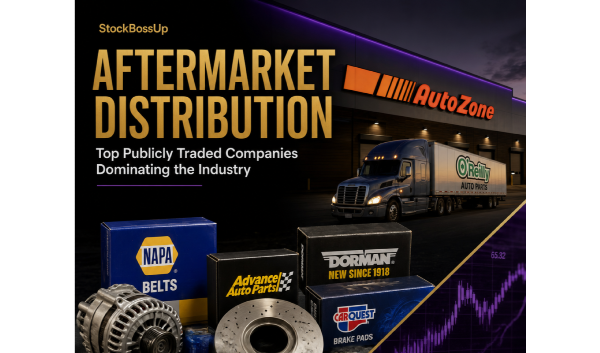
Top Publicly Traded Companies Dominating Aftermarket Distribution
The auto parts industry looks simple on the surface. A driver needs brakes, a battery, or an oil filter, and they buy it from a store or online. But behind that simple experience is a highly controlled distribution system.
A small group of publicly traded companies moves most of the replacement parts in North America. These firms decide what is in stock, how fast it arrives, and often how much it costs.
The real issue is not access to parts. It is control of the system that delivers them. The answer to who holds that control is not obvious until you look at the structure of the industry.
Why Do So Few Companies Control Most Auto Parts Distribution?
The aftermarket is massive and constantly growing. Vehicles wear out faster than they are replaced, and every car needs ongoing repairs.
But distribution is expensive. It requires warehouses, logistics networks, inventory systems, and store locations spread across the country. That scale creates high barriers for new competitors.
Once companies reach national scale, their cost per transaction drops. Smaller companies cannot match their pricing or speed.
This naturally concentrates power in a few large firms that already built the infrastructure.
How AutoZone and O’Reilly Built Nationwide Dominance
AutoZone and O’Reilly Automotive are two of the strongest players in the market.
Both companies rely heavily on dense store networks. Most customers need parts immediately, not days later. This makes physical proximity a major advantage.
Their model focuses on rapid inventory turnover and regional distribution hubs. Stores are supplied multiple times per day in many regions.
A key difference is focus. AutoZone leans heavily into DIY retail customers, while O’Reilly Automotive has a stronger balance between DIY and professional mechanics.
What Makes Advance Auto Parts Compete Differently?
Advance Auto Parts operates in the same space but has shifted more toward professional customers.
Professional repair shops place larger and more consistent orders. This gives Advance Auto Parts steadier revenue compared to purely consumer-focused models.
However, competition is intense. Pricing pressure is constant, and logistics efficiency often determines profitability.
The company has been restructuring its store footprint and supply chain to better compete with larger rivals.
Why Genuine Parts Company Is a Hidden Giant
Genuine Parts Company operates differently from most competitors.
Through its NAPA Auto Parts network, it serves both retail customers and professional repair shops. It also has a large industrial division that supplies manufacturing and maintenance operations.
This diversification helps stabilize revenue during slow automotive cycles.
A lesser-known strength is its deep integration with independent repair shops, which rely on its distribution system daily.
How LKQ Corporation Changed the Parts Market
LKQ Corporation focuses on recycled and remanufactured parts rather than only new components.
This gives it a different role in the ecosystem. Instead of competing only on speed, it competes on cost and availability of used parts.
The company operates salvage yards, dismantling facilities, and large-scale distribution centers.
One unique advantage is its global sourcing network, which allows it to recover parts from a wide range of vehicle markets.
How These Companies Avoid Direct Price Competition
Even though they compete, the market is structured into segments:
- AutoZone focuses on DIY retail demand
- O’Reilly Automotive balances DIY and professional buyers
- Advance Auto Parts targets professional installers
- Genuine Parts Company serves both retail and industrial markets
- LKQ Corporation focuses on recycled and cost-sensitive parts
| Company |
Primary Market |
Strength |
Key Advantage |
| AutoZone |
DIY retail |
Store density |
Fast availability |
| O’Reilly Automotive |
Mixed DIY + pro |
Hybrid model |
Balanced distribution |
| Advance Auto Parts |
Professional shops |
Commercial accounts |
Bulk stability |
| Genuine Parts Company |
Retail + industrial |
NAPA network |
Diversified demand |
| LKQ Corporation |
Recycled parts |
Salvage sourcing |
Lower-cost supply |
Why Logistics Is the Real Competitive Advantage
In aftermarket distribution, logistics matters more than branding.
Customers want the right part immediately. Even a one-day delay can send them to a competitor.
Companies invest heavily in regional distribution centers and real-time inventory systems.
Reverse logistics is also important. Many parts are returned due to compatibility issues. Efficient handling of returns reduces losses.
Large companies dominate because they can absorb complexity that smaller firms cannot manage efficiently.
How Digital Ordering Changed the Industry
Modern aftermarket systems now include digital ordering tools for both consumers and professional shops.
Repair shops can check inventory, place orders, and schedule deliveries in real time.
Even online orders depend on physical distribution networks behind the scenes.
Digital tools improve speed, but they do not replace logistics infrastructure. They amplify it.
Why Smaller Competitors Struggle to Survive
Smaller distributors face structural disadvantages.
They cannot spread logistics costs across enough transactions, making pricing less competitive.
Manufacturers also prefer working with large distributors that can guarantee volume and consistency.
As a result, smaller companies often shift into niche or regional markets.
What Could Disrupt These Market Leaders?
Electric vehicles reduce the number of traditional moving parts, which may lower long-term demand for some components.
However, EVs introduce new categories of repair demand, especially electronics and software systems.
Another risk is supply chain disruption. Global sourcing dependencies can affect availability and pricing.
Despite these challenges, the overall vehicle fleet is aging, which continues to support strong aftermarket demand.
How These Companies Influence Everyday Repairs
Most drivers interact with this system without realizing it.
A simple brake replacement or battery swap likely involves parts that passed through one of these distribution networks.
These companies shape repair speed, cost, and even how long vehicles stay on the road.
Stronger distribution systems extend vehicle life by making repairs easier and more affordable.
What Defines True Dominance in Aftermarket Distribution?
Market dominance is not just about revenue. It is about control of movement.
The companies leading this industry control how parts flow from manufacturers to repair shops and consumers.
They influence availability, pricing, and speed at a national scale.
This control is what keeps them at the center of the aftermarket system.
Final Insight: The System Behind Every Repair
The aftermarket looks fragmented, but it is actually highly centralized.
A small group of publicly traded companies forms the backbone of auto parts distribution in North America.
Their strength comes from logistics, scale, and infrastructure rather than just product selection.
The real competition is not about who sells parts. It is about who controls access to them.








🔑 Key Takeaways: Top Publicly Traded Companies Dominating Aftermarket Distribution
🚗 Major publicly traded companies control most aftermarket auto parts distribution
A small group of firms—including AutoZone, O’Reilly Automotive, Advance Auto Parts, Genuine Parts Company, and LKQ Corporation—dominate the U.S. automotive aftermarket. Their scale allows them to control pricing, availability, and distribution speed across thousands of locations.
📦 Logistics and scale matter more than branding in auto parts retail
The real competitive advantage comes from distribution networks, not just product selection. Companies with large warehouse systems and fast regional delivery can consistently outperform smaller competitors on speed, cost, and reliability.
🔧 The aftermarket is segmented to reduce direct competition pressure
Each major company focuses on a different demand layer—DIY retail, professional mechanics, industrial supply, or recycled parts. This segmentation helps stabilize margins and prevents direct price collapse across the industry.
⚡ Industry dominance is shifting as EVs and digital systems reshape demand
Electric vehicles reduce traditional mechanical part demand, while increasing electronics-related repairs. At the same time, digital ordering systems are making distribution faster, but still dependent on physical logistics infrastructure.
Top Publicly Traded Companies Dominating Aftermarket Distribution
The auto parts industry looks simple on the surface. A driver needs brakes, a battery, or an oil filter, and they buy it from a store or online. But behind that simple experience is a highly controlled distribution system.
A small group of publicly traded companies moves most of the replacement parts in North America. These firms decide what is in stock, how fast it arrives, and often how much it costs.
The real issue is not access to parts. It is control of the system that delivers them. The answer to who holds that control is not obvious until you look at the structure of the industry.
Why Do So Few Companies Control Most Auto Parts Distribution?
The aftermarket is massive and constantly growing. Vehicles wear out faster than they are replaced, and every car needs ongoing repairs.
But distribution is expensive. It requires warehouses, logistics networks, inventory systems, and store locations spread across the country. That scale creates high barriers for new competitors.
Once companies reach national scale, their cost per transaction drops. Smaller companies cannot match their pricing or speed.
This naturally concentrates power in a few large firms that already built the infrastructure.
How AutoZone and O’Reilly Built Nationwide Dominance
AutoZone and O’Reilly Automotive are two of the strongest players in the market.
Both companies rely heavily on dense store networks. Most customers need parts immediately, not days later. This makes physical proximity a major advantage.
Their model focuses on rapid inventory turnover and regional distribution hubs. Stores are supplied multiple times per day in many regions.
A key difference is focus. AutoZone leans heavily into DIY retail customers, while O’Reilly Automotive has a stronger balance between DIY and professional mechanics.
What Makes Advance Auto Parts Compete Differently?
Advance Auto Parts operates in the same space but has shifted more toward professional customers.
Professional repair shops place larger and more consistent orders. This gives Advance Auto Parts steadier revenue compared to purely consumer-focused models.
However, competition is intense. Pricing pressure is constant, and logistics efficiency often determines profitability.
The company has been restructuring its store footprint and supply chain to better compete with larger rivals.
Why Genuine Parts Company Is a Hidden Giant
Genuine Parts Company operates differently from most competitors.
Through its NAPA Auto Parts network, it serves both retail customers and professional repair shops. It also has a large industrial division that supplies manufacturing and maintenance operations.
This diversification helps stabilize revenue during slow automotive cycles.
A lesser-known strength is its deep integration with independent repair shops, which rely on its distribution system daily.
How LKQ Corporation Changed the Parts Market
LKQ Corporation focuses on recycled and remanufactured parts rather than only new components.
This gives it a different role in the ecosystem. Instead of competing only on speed, it competes on cost and availability of used parts.
The company operates salvage yards, dismantling facilities, and large-scale distribution centers.
One unique advantage is its global sourcing network, which allows it to recover parts from a wide range of vehicle markets.
How These Companies Avoid Direct Price Competition
Even though they compete, the market is structured into segments:
Why Logistics Is the Real Competitive Advantage
In aftermarket distribution, logistics matters more than branding.
Customers want the right part immediately. Even a one-day delay can send them to a competitor.
Companies invest heavily in regional distribution centers and real-time inventory systems.
Reverse logistics is also important. Many parts are returned due to compatibility issues. Efficient handling of returns reduces losses.
Large companies dominate because they can absorb complexity that smaller firms cannot manage efficiently.
How Digital Ordering Changed the Industry
Modern aftermarket systems now include digital ordering tools for both consumers and professional shops.
Repair shops can check inventory, place orders, and schedule deliveries in real time.
Even online orders depend on physical distribution networks behind the scenes.
Digital tools improve speed, but they do not replace logistics infrastructure. They amplify it.
Why Smaller Competitors Struggle to Survive
Smaller distributors face structural disadvantages.
They cannot spread logistics costs across enough transactions, making pricing less competitive.
Manufacturers also prefer working with large distributors that can guarantee volume and consistency.
As a result, smaller companies often shift into niche or regional markets.
What Could Disrupt These Market Leaders?
Electric vehicles reduce the number of traditional moving parts, which may lower long-term demand for some components.
However, EVs introduce new categories of repair demand, especially electronics and software systems.
Another risk is supply chain disruption. Global sourcing dependencies can affect availability and pricing.
Despite these challenges, the overall vehicle fleet is aging, which continues to support strong aftermarket demand.
How These Companies Influence Everyday Repairs
Most drivers interact with this system without realizing it.
A simple brake replacement or battery swap likely involves parts that passed through one of these distribution networks.
These companies shape repair speed, cost, and even how long vehicles stay on the road.
Stronger distribution systems extend vehicle life by making repairs easier and more affordable.
What Defines True Dominance in Aftermarket Distribution?
Market dominance is not just about revenue. It is about control of movement.
The companies leading this industry control how parts flow from manufacturers to repair shops and consumers.
They influence availability, pricing, and speed at a national scale.
This control is what keeps them at the center of the aftermarket system.
Final Insight: The System Behind Every Repair
The aftermarket looks fragmented, but it is actually highly centralized.
A small group of publicly traded companies forms the backbone of auto parts distribution in North America.
Their strength comes from logistics, scale, and infrastructure rather than just product selection.
The real competition is not about who sells parts. It is about who controls access to them.