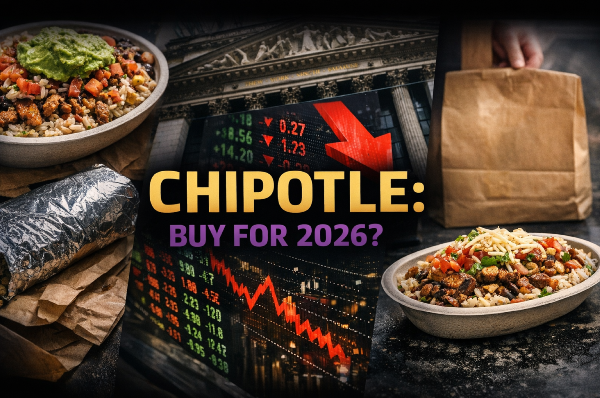
Chipotle stock has taken a beating—down 44% year‑to‑date in 2025—and that kind of decline forces every long‑term investor to pause and reassess. For years, the company looked unstoppable. Execution was sharp, growth was consistent, and the brand seemed to glide through challenges that would have crushed lesser restaurant chains. But no company performs flawlessly forever, and the cracks that were once theoretical are now showing up in the numbers.
So the big question is simple: Does this massive pullback finally make Chipotle attractive going into 2026? Let’s walk through the fundamentals, the headwinds, the leadership changes, and the valuation to see where things stand.
A Decade of Strength Meets a Year of Reality
Chipotle spent the last decade transforming itself from a troubled brand into one of the strongest restaurant operators in the world. Revenue climbed from $3.9 billion in 2016 to $11.8 billion in the most recent trailing twelve‑month period. That kind of growth doesn’t happen by accident. It came from operational discipline, menu consistency, digital ordering innovation, and a leadership team that executed at a high level.
But the company’s past success doesn’t shield it from the present. The restaurant industry in 2025 is facing a very different consumer environment. People are visiting restaurants 4–5% less often than they did in 2024. Prices are higher everywhere—groceries, gas, rent, utilities—and discretionary spending is getting squeezed. When budgets tighten, eating out is one of the first luxuries to go.
Chipotle isn’t immune to that shift, and the slowdown is showing up in its performance metrics.
Revenue Growth Snapshot
| Year |
Revenue (Billions) |
| 2016 |
$3.9B |
| 2024/TTM |
$11.8B |
Leadership Changes Add Another Layer of Uncertainty
One of the biggest drivers of Chipotle’s turnaround was former CEO Brian Niccol. He stepped in after the company’s food‑safety crisis and rebuilt trust, improved operations, and reignited growth. His leadership was a major reason Chipotle became one of the best‑performing restaurant stocks of the past decade.
But Niccol was eventually poached by Starbucks, leaving Chipotle searching for a leader capable of maintaining that same level of excellence. Leadership transitions are always tricky, especially when the outgoing CEO was responsible for a dramatic turnaround. Even small shifts in strategy or execution can ripple through the business.
And we’re already seeing some of those ripples. Policies implemented under the previous leadership team are now being carried out by a new one, and the transition hasn’t been seamless. Combine that with a tougher consumer environment, and the headwinds become even more noticeable.
Returns on Invested Capital: A Warning Sign?
One of the clearest indicators of Chipotle’s operational strength has been its returns on invested capital (ROIC). Under Niccol, ROIC surged from 1.2% to 32% by 2024—an extraordinary margin for a restaurant chain, especially one that owns all its locations rather than franchising them.
But now, ROIC is slipping. It has already dipped from 32% to 30%, and given the economic pressures and leadership transition, further declines seem likely.
Still, even at 30%, Chipotle’s ROIC remains elite. Most restaurant companies would celebrate numbers half that high. The concern isn’t that Chipotle is suddenly a weak operator—it’s that the trend is moving in the wrong direction at the same time the stock price is falling.
ROIC Trend
| Year |
ROIC |
| 2016 |
1.2% |
| 2024 |
32% |
| 2025 |
30% |
Valuation: Finally Attractive After Years of Being Too Expensive
For years, Chipotle was a phenomenal company with a not‑so‑phenomenal price tag. Investors were paying a premium for perfection, and perfection rarely lasts forever. That’s why the stock’s 44% decline is so important—it finally brings valuation back to earth.
Chipotle now trades at:
- Forward P/E: 29
- Forward Price‑to‑Operating Cash Flow: 21
These are some of the lowest multiples investors have seen since 2021. For a company with Chipotle’s brand strength, margins, and long‑term growth potential, these levels are unusually reasonable.
And when running a discounted cash flow valuation, the intrinsic value comes out to $45 per share, compared to a current market price of $34. That’s a meaningful discount—something Chipotle rarely offers.
Valuation Metrics
| Metric |
Value |
| Forward P/E |
29 |
| Forward Price‑to‑OCF |
21 |
| Intrinsic Value |
$45 |
| Market Price |
$34 |
The Big Question: Is Chipotle a Buy for 2026?
After years of caution, the setup finally looks different. The stock is cheaper. The valuation is reasonable. The long‑term fundamentals remain strong. And even though headwinds exist—consumer spending pressure, leadership transition, and declining ROIC—the company is still operating at a level most restaurant chains can only dream of.
The key shift is that investors are no longer paying a perfection premium. They’re paying a fair price for a great business facing temporary challenges.
That’s a very different risk‑reward profile than what we’ve seen over the past several years.
Final Take: Buy, Hold, or Sell?
Given the combination of:
- A 44% stock price decline
- A return to attractive valuation levels
- A DCF‑based intrinsic value above the current price
- A still‑strong ROIC despite recent declines
- A brand with long‑term staying power
Chipotle stock looks like a BUY going into 2026.
The risks are real, but the price finally compensates for them.
https://youtu.be/nFfbp_hC6Ys?si=laFY_8srCm-wmTFs






Chipotle stock has taken a beating—down 44% year‑to‑date in 2025—and that kind of decline forces every long‑term investor to pause and reassess. For years, the company looked unstoppable. Execution was sharp, growth was consistent, and the brand seemed to glide through challenges that would have crushed lesser restaurant chains. But no company performs flawlessly forever, and the cracks that were once theoretical are now showing up in the numbers.
So the big question is simple: Does this massive pullback finally make Chipotle attractive going into 2026? Let’s walk through the fundamentals, the headwinds, the leadership changes, and the valuation to see where things stand.
A Decade of Strength Meets a Year of Reality
Chipotle spent the last decade transforming itself from a troubled brand into one of the strongest restaurant operators in the world. Revenue climbed from $3.9 billion in 2016 to $11.8 billion in the most recent trailing twelve‑month period. That kind of growth doesn’t happen by accident. It came from operational discipline, menu consistency, digital ordering innovation, and a leadership team that executed at a high level.
But the company’s past success doesn’t shield it from the present. The restaurant industry in 2025 is facing a very different consumer environment. People are visiting restaurants 4–5% less often than they did in 2024. Prices are higher everywhere—groceries, gas, rent, utilities—and discretionary spending is getting squeezed. When budgets tighten, eating out is one of the first luxuries to go.
Chipotle isn’t immune to that shift, and the slowdown is showing up in its performance metrics.
Revenue Growth Snapshot
Leadership Changes Add Another Layer of Uncertainty
One of the biggest drivers of Chipotle’s turnaround was former CEO Brian Niccol. He stepped in after the company’s food‑safety crisis and rebuilt trust, improved operations, and reignited growth. His leadership was a major reason Chipotle became one of the best‑performing restaurant stocks of the past decade.
But Niccol was eventually poached by Starbucks, leaving Chipotle searching for a leader capable of maintaining that same level of excellence. Leadership transitions are always tricky, especially when the outgoing CEO was responsible for a dramatic turnaround. Even small shifts in strategy or execution can ripple through the business.
And we’re already seeing some of those ripples. Policies implemented under the previous leadership team are now being carried out by a new one, and the transition hasn’t been seamless. Combine that with a tougher consumer environment, and the headwinds become even more noticeable.
Returns on Invested Capital: A Warning Sign?
One of the clearest indicators of Chipotle’s operational strength has been its returns on invested capital (ROIC). Under Niccol, ROIC surged from 1.2% to 32% by 2024—an extraordinary margin for a restaurant chain, especially one that owns all its locations rather than franchising them.
But now, ROIC is slipping. It has already dipped from 32% to 30%, and given the economic pressures and leadership transition, further declines seem likely.
Still, even at 30%, Chipotle’s ROIC remains elite. Most restaurant companies would celebrate numbers half that high. The concern isn’t that Chipotle is suddenly a weak operator—it’s that the trend is moving in the wrong direction at the same time the stock price is falling.
ROIC Trend
Valuation: Finally Attractive After Years of Being Too Expensive
For years, Chipotle was a phenomenal company with a not‑so‑phenomenal price tag. Investors were paying a premium for perfection, and perfection rarely lasts forever. That’s why the stock’s 44% decline is so important—it finally brings valuation back to earth.
Chipotle now trades at:
These are some of the lowest multiples investors have seen since 2021. For a company with Chipotle’s brand strength, margins, and long‑term growth potential, these levels are unusually reasonable.
And when running a discounted cash flow valuation, the intrinsic value comes out to $45 per share, compared to a current market price of $34. That’s a meaningful discount—something Chipotle rarely offers.
Valuation Metrics
The Big Question: Is Chipotle a Buy for 2026?
After years of caution, the setup finally looks different. The stock is cheaper. The valuation is reasonable. The long‑term fundamentals remain strong. And even though headwinds exist—consumer spending pressure, leadership transition, and declining ROIC—the company is still operating at a level most restaurant chains can only dream of.
The key shift is that investors are no longer paying a perfection premium. They’re paying a fair price for a great business facing temporary challenges.
That’s a very different risk‑reward profile than what we’ve seen over the past several years.
Final Take: Buy, Hold, or Sell?
Given the combination of:
Chipotle stock looks like a BUY going into 2026.
The risks are real, but the price finally compensates for them.
https://youtu.be/nFfbp_hC6Ys?si=laFY_8srCm-wmTFs