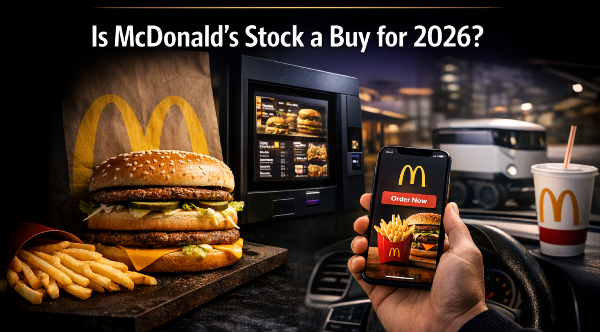
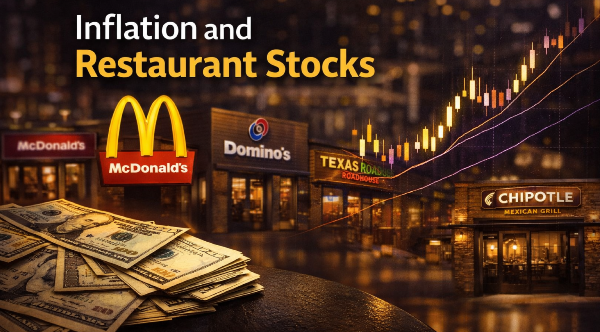
McDonald’s stock has quietly delivered a solid run in 2025. Shares are up more than 7% year‑to‑date, and when you add in the dividends, investors have enjoyed a strong return for the relatively low risk that comes with owning a global giant like McDonald’s. The company continues to prove why it’s one of the most durable businesses in the world. But the real question investors are asking now is simple: What about 2026?
Is McDonald’s setting up for another year of steady gains, or is the stock already priced for perfection? Let’s break down the numbers, the technology shifts, and the long‑term outlook to see whether the Golden Arches still shine for investors heading into next year.
Revenue Growth Has Quietly Rebounded
One of the biggest drivers behind McDonald’s recent performance is the company’s operational enhancements. After revenues crashed to $19.2 billion in 2020, the business has staged a powerful comeback, climbing to $26.3 billion in recent years. That rebound didn’t happen by accident. It came from a combination of strategic improvements, disciplined execution, and a willingness to embrace technology at scale.
McDonald’s is not a company that will ever grow revenue by double digits again. With more than 40,000 locations worldwide, the brand is already operating at massive scale. The opportunities for expansion are limited, but that doesn’t mean growth is dead. Instead, the company is finding new ways to squeeze more efficiency and value out of its existing footprint.
Revenue Recovery Snapshot
| Year |
Revenue (Billions) |
| 2020 |
$19.2B |
| Recent Years |
$26.3B |
This rebound sets the stage for the next phase of McDonald’s evolution—one powered not by new stores, but by smarter operations.
Technology Is Becoming McDonald’s Secret Weapon
If there’s one theme shaping McDonald’s future, it’s technology. The company’s digital enhancements have been a major catalyst for growth, and customers have responded extremely well. The McDonald’s app, mobile ordering, and digital sales channels have become central to the brand’s strategy.
The app alone delivers multiple benefits. First, it reduces the workload on employees. When customers order ahead, place delivery orders, or use curbside pickup, it takes pressure off cashiers and drive‑thru staff. Second, digital systems don’t take days off. Once the infrastructure is built, it scales without requiring hourly wages.
This shift improves the company’s cost structure while also making the customer experience more convenient. Ordering ahead and having food brought directly to your car is simply easier than waiting in a drive‑thru line and repeating your order to a speaker box.
Operational Benefits of Digital Ordering
| Benefit |
Impact |
| Reduced employee strain |
Fewer cashier interactions needed |
| Lower labor costs |
Digital systems don’t require hourly pay |
| Faster order fulfillment |
Orders prepared before arrival |
| Higher customer satisfaction |
Convenience and speed |
These improvements are already meaningful, but the next wave of innovation could be even bigger.
AI and Automation Are Reshaping the Drive‑Thru
Artificial intelligence is becoming a major part of McDonald’s operational strategy. Many restaurants are already using AI to take drive‑thru orders, and McDonald’s is leaning into this trend. AI‑powered ordering reduces labor costs, improves accuracy, and speeds up service times.
In Los Angeles, autonomous delivery robots are also gaining traction. As these systems scale, delivery costs could fall dramatically. Lower delivery costs mean higher margins and a larger addressable market for off‑premise dining—an area where McDonald’s already excels.
The combination of AI ordering, automation, and robotics could meaningfully reduce operational strain and unlock new efficiencies across thousands of locations.
Returns on Capital Remain Strong
McDonald’s has consistently generated returns on invested capital well above its weighted average cost of capital. That’s a sign of a high‑quality business with strong competitive advantages. With technology reducing labor intensity and improving throughput, those returns could remain elevated for years to come.
Even with these strengths, the stock’s valuation is surprisingly reasonable. On a forward basis, McDonald’s trades at:
- Forward P/E: 24
- Forward Price‑to‑Operating Cash Flow: 21
Those numbers are roughly in line with the average stock in the S&P 500. But McDonald’s is not an average business. It’s one of the most efficient, profitable, and well‑run companies in the world.
Valuation Snapshot
| Metric |
Value |
| Forward P/E |
24 |
| Forward Price-to-OCF |
21 |
| Analyst Fair Value Estimate |
$417/share |
| Current Price (Referenced) |
$311/share |
Based on a discounted cash flow model, the fair value estimate comes out to $417 per share, suggesting the stock is undervalued at around $311.
Why the Stock Still Looks Attractive for 2026
When you combine the company’s operational strength, digital momentum, and reasonable valuation, the investment case becomes clear. McDonald’s is not a high‑growth stock, but it doesn’t need to be. It’s a stable, cash‑generating machine with a long runway for efficiency improvements.
The optionality from technology—AI ordering, app‑driven sales, autonomous delivery—creates a path for margin expansion even without major revenue growth. That’s a powerful setup for long‑term investors who value consistency and durability.
McDonald’s also continues to reward shareholders through dividends, which enhances total returns and makes the stock appealing for income‑focused investors.
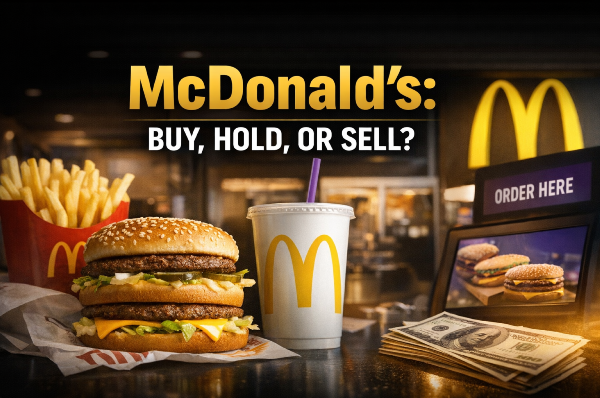
Final Thoughts: Is McDonald’s a Buy, Hold, or Sell?
McDonald’s enters 2026 with strong fundamentals, rising digital adoption, and a valuation that doesn’t fully reflect its operational advantages. The company has proven it can adapt, innovate, and deliver steady returns even in challenging environments.
Based on the analysis presented, McDonald’s stock is a BUY.
https://youtu.be/EC5V4bZONbI?si=iywZGyS89XJZv17K


















McDonald’s stock has quietly delivered a solid run in 2025. Shares are up more than 7% year‑to‑date, and when you add in the dividends, investors have enjoyed a strong return for the relatively low risk that comes with owning a global giant like McDonald’s. The company continues to prove why it’s one of the most durable businesses in the world. But the real question investors are asking now is simple: What about 2026?
Is McDonald’s setting up for another year of steady gains, or is the stock already priced for perfection? Let’s break down the numbers, the technology shifts, and the long‑term outlook to see whether the Golden Arches still shine for investors heading into next year.
Revenue Growth Has Quietly Rebounded
One of the biggest drivers behind McDonald’s recent performance is the company’s operational enhancements. After revenues crashed to $19.2 billion in 2020, the business has staged a powerful comeback, climbing to $26.3 billion in recent years. That rebound didn’t happen by accident. It came from a combination of strategic improvements, disciplined execution, and a willingness to embrace technology at scale.
McDonald’s is not a company that will ever grow revenue by double digits again. With more than 40,000 locations worldwide, the brand is already operating at massive scale. The opportunities for expansion are limited, but that doesn’t mean growth is dead. Instead, the company is finding new ways to squeeze more efficiency and value out of its existing footprint.
Revenue Recovery Snapshot
This rebound sets the stage for the next phase of McDonald’s evolution—one powered not by new stores, but by smarter operations.
Technology Is Becoming McDonald’s Secret Weapon
If there’s one theme shaping McDonald’s future, it’s technology. The company’s digital enhancements have been a major catalyst for growth, and customers have responded extremely well. The McDonald’s app, mobile ordering, and digital sales channels have become central to the brand’s strategy.
The app alone delivers multiple benefits. First, it reduces the workload on employees. When customers order ahead, place delivery orders, or use curbside pickup, it takes pressure off cashiers and drive‑thru staff. Second, digital systems don’t take days off. Once the infrastructure is built, it scales without requiring hourly wages.
This shift improves the company’s cost structure while also making the customer experience more convenient. Ordering ahead and having food brought directly to your car is simply easier than waiting in a drive‑thru line and repeating your order to a speaker box.
Operational Benefits of Digital Ordering
These improvements are already meaningful, but the next wave of innovation could be even bigger.
AI and Automation Are Reshaping the Drive‑Thru
Artificial intelligence is becoming a major part of McDonald’s operational strategy. Many restaurants are already using AI to take drive‑thru orders, and McDonald’s is leaning into this trend. AI‑powered ordering reduces labor costs, improves accuracy, and speeds up service times.
In Los Angeles, autonomous delivery robots are also gaining traction. As these systems scale, delivery costs could fall dramatically. Lower delivery costs mean higher margins and a larger addressable market for off‑premise dining—an area where McDonald’s already excels.
The combination of AI ordering, automation, and robotics could meaningfully reduce operational strain and unlock new efficiencies across thousands of locations.
Returns on Capital Remain Strong
McDonald’s has consistently generated returns on invested capital well above its weighted average cost of capital. That’s a sign of a high‑quality business with strong competitive advantages. With technology reducing labor intensity and improving throughput, those returns could remain elevated for years to come.
Even with these strengths, the stock’s valuation is surprisingly reasonable. On a forward basis, McDonald’s trades at:
Those numbers are roughly in line with the average stock in the S&P 500. But McDonald’s is not an average business. It’s one of the most efficient, profitable, and well‑run companies in the world.
Valuation Snapshot
Based on a discounted cash flow model, the fair value estimate comes out to $417 per share, suggesting the stock is undervalued at around $311.
Why the Stock Still Looks Attractive for 2026
When you combine the company’s operational strength, digital momentum, and reasonable valuation, the investment case becomes clear. McDonald’s is not a high‑growth stock, but it doesn’t need to be. It’s a stable, cash‑generating machine with a long runway for efficiency improvements.
The optionality from technology—AI ordering, app‑driven sales, autonomous delivery—creates a path for margin expansion even without major revenue growth. That’s a powerful setup for long‑term investors who value consistency and durability.
McDonald’s also continues to reward shareholders through dividends, which enhances total returns and makes the stock appealing for income‑focused investors.
Final Thoughts: Is McDonald’s a Buy, Hold, or Sell?
McDonald’s enters 2026 with strong fundamentals, rising digital adoption, and a valuation that doesn’t fully reflect its operational advantages. The company has proven it can adapt, innovate, and deliver steady returns even in challenging environments.
Based on the analysis presented, McDonald’s stock is a BUY.
https://youtu.be/EC5V4bZONbI?si=iywZGyS89XJZv17K