🔑 Key Takeaways
🚗 ADAS is turning braking from a mechanical system into a software-managed function
Advanced Driver Assistance Systems (ADAS) increasingly control braking decisions using sensors, cameras, radar, and onboard computers. This shifts brake suppliers toward electronically controlled and software-integrated systems.
🏭 Tier 1 suppliers gain more control as braking becomes part of integrated vehicle intelligence
Companies like Bosch, Continental, and ZF Friedrichshafen are no longer just supplying brake hardware. They are delivering full braking + stability + driver assistance ecosystems that lock them deeper into OEM platforms.
⚡ Sensor fusion is increasing component complexity and raising supplier value per vehicle
Brake systems now interact with radar, lidar, and camera inputs. This increases semiconductor usage, software complexity, and the overall value of each braking system per vehicle.
📈 ADAS adoption increases supplier lock-in and extends platform lifecycles
Once ADAS braking systems are validated and deployed, they are difficult and expensive to replace. This creates long-term contracts and sticky supplier relationships across vehicle generations.
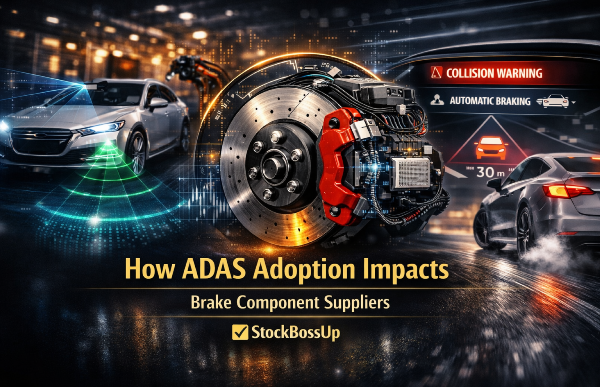
How ADAS Adoption Impacts Brake Component Suppliers
Brakes used to be simple in concept. Press pedal, create friction, stop the car.
ADAS changed that simplicity. Now braking decisions can be influenced—or fully triggered—by onboard systems that interpret the world in real time.
That shift quietly moved braking from a mechanical domain into a software-defined safety system.
Why ADAS Systems Now Sit Inside the Brake Pathway
ADAS systems are designed to prevent accidents before they happen. That means they often intervene directly in braking.
Features like automatic emergency braking, lane-keeping assist, and adaptive cruise control all rely on braking intervention.
This creates a direct link between sensors and brake actuators.
| ADAS Feature |
Brake Interaction |
System Role |
| Automatic emergency braking |
Full brake activation |
Collision prevention |
| Adaptive cruise control |
Speed modulation |
Traffic flow control |
| Lane keeping assist |
Minor braking adjustments |
Steering correction support |
| Forward collision warning |
Pre-brake priming |
Driver alert system |
A subtle detail is that some systems begin braking milliseconds before a driver perceives danger, based entirely on sensor prediction models.
Why Brake Suppliers Are Becoming System Integrators
Traditional brake suppliers focused on friction materials, hydraulics, and mechanical reliability.
ADAS integration forces them into a broader role that includes electronics and software coordination.
Bosch is a strong example of this shift, combining braking hardware with stability control and driver assistance systems. Continental follows a similar path by merging braking with ADAS sensor processing. ZF Friedrichshafen integrates braking into full chassis control systems.
| Company |
Role Shift |
ADAS Contribution |
| Bosch |
Mechanical → integrated systems |
Brake + stability + automation |
| Continental |
Component → platform systems |
ADAS + braking integration |
| ZF Friedrichshafen |
Chassis supplier → control systems |
Vehicle dynamics + braking |
| Brembo |
Performance braking focus |
High-end assisted braking systems |
This convergence means braking is no longer sold as a standalone component in many cases. It is bundled into larger control platforms.
How Sensor Fusion Changes Brake System Design
ADAS braking depends on sensor fusion, which combines multiple data sources into one decision model.
Radar detects distance and speed. Cameras interpret objects and lanes. Lidar maps surroundings in detail. All of this data is processed in real time before a braking decision is made.
That processing requires tighter integration between hardware and software than traditional braking systems ever needed.
| Sensor Type |
Function |
Brake System Impact |
| Radar |
Distance + speed detection |
Collision prediction |
| Camera |
Object recognition |
Lane + vehicle detection |
| Lidar |
Spatial mapping |
Precision braking input |
| Ultrasonic sensors |
Close-range detection |
Parking + low-speed braking |
A less obvious detail is that braking decisions in ADAS systems are often based on probabilistic models rather than fixed thresholds, meaning the system is constantly recalculating risk in real time.
Why ADAS Increases Supplier Lock-In
Once an ADAS braking system is integrated into a vehicle platform, replacing it becomes extremely difficult.
The system is tied into software, sensors, calibration routines, and safety certification. Any change requires full retesting.
This creates long-term supplier relationships that can last the entire lifecycle of a vehicle model.
| Factor |
Lock-In Effect |
| Safety certification |
Extremely high switching cost |
| Software integration |
Platform dependency |
| Sensor calibration |
Vehicle-specific tuning |
| OEM validation cycles |
Multi-year commitment |
This is one of the most important structural advantages for Tier 1 suppliers in the ADAS era.
Why Braking Systems Now Have Higher Per-Vehicle Value
ADAS systems increase the number of components involved in braking decisions.
That includes sensors, control units, actuators, and software layers working together.
As a result, the value per braking system increases even if physical brake wear decreases in some driving conditions.
| System Layer |
Contribution |
Value Impact |
| Mechanical brakes |
Physical stopping power |
Stable baseline |
| Electronic control unit |
Decision processing |
High value add |
| Sensors |
Environmental input |
Growing value |
| Software logic |
System intelligence |
Critical layer |
This shift moves braking from a commodity component toward a high-value integrated system.
Where ADAS Braking Is Heading Next
ADAS braking systems are evolving toward higher levels of autonomy.
As vehicles move toward partial and conditional automation, braking will become increasingly predictive rather than reactive.
That means suppliers will need to balance mechanical reliability with software intelligence in a single system.
In the end, ADAS is not just improving braking performance. It is redefining what braking actually is inside modern vehicles.




















🔑 Key Takeaways
🚗 ADAS is turning braking from a mechanical system into a software-managed function
Advanced Driver Assistance Systems (ADAS) increasingly control braking decisions using sensors, cameras, radar, and onboard computers. This shifts brake suppliers toward electronically controlled and software-integrated systems.
🏭 Tier 1 suppliers gain more control as braking becomes part of integrated vehicle intelligence
Companies like Bosch, Continental, and ZF Friedrichshafen are no longer just supplying brake hardware. They are delivering full braking + stability + driver assistance ecosystems that lock them deeper into OEM platforms.
⚡ Sensor fusion is increasing component complexity and raising supplier value per vehicle
Brake systems now interact with radar, lidar, and camera inputs. This increases semiconductor usage, software complexity, and the overall value of each braking system per vehicle.
📈 ADAS adoption increases supplier lock-in and extends platform lifecycles
Once ADAS braking systems are validated and deployed, they are difficult and expensive to replace. This creates long-term contracts and sticky supplier relationships across vehicle generations.
How ADAS Adoption Impacts Brake Component Suppliers
Brakes used to be simple in concept. Press pedal, create friction, stop the car.
ADAS changed that simplicity. Now braking decisions can be influenced—or fully triggered—by onboard systems that interpret the world in real time.
That shift quietly moved braking from a mechanical domain into a software-defined safety system.
Why ADAS Systems Now Sit Inside the Brake Pathway
ADAS systems are designed to prevent accidents before they happen. That means they often intervene directly in braking.
Features like automatic emergency braking, lane-keeping assist, and adaptive cruise control all rely on braking intervention.
This creates a direct link between sensors and brake actuators.
A subtle detail is that some systems begin braking milliseconds before a driver perceives danger, based entirely on sensor prediction models.
Why Brake Suppliers Are Becoming System Integrators
Traditional brake suppliers focused on friction materials, hydraulics, and mechanical reliability.
ADAS integration forces them into a broader role that includes electronics and software coordination.
Bosch is a strong example of this shift, combining braking hardware with stability control and driver assistance systems. Continental follows a similar path by merging braking with ADAS sensor processing. ZF Friedrichshafen integrates braking into full chassis control systems.
This convergence means braking is no longer sold as a standalone component in many cases. It is bundled into larger control platforms.
How Sensor Fusion Changes Brake System Design
ADAS braking depends on sensor fusion, which combines multiple data sources into one decision model.
Radar detects distance and speed. Cameras interpret objects and lanes. Lidar maps surroundings in detail. All of this data is processed in real time before a braking decision is made.
That processing requires tighter integration between hardware and software than traditional braking systems ever needed.
A less obvious detail is that braking decisions in ADAS systems are often based on probabilistic models rather than fixed thresholds, meaning the system is constantly recalculating risk in real time.
Why ADAS Increases Supplier Lock-In
Once an ADAS braking system is integrated into a vehicle platform, replacing it becomes extremely difficult.
The system is tied into software, sensors, calibration routines, and safety certification. Any change requires full retesting.
This creates long-term supplier relationships that can last the entire lifecycle of a vehicle model.
This is one of the most important structural advantages for Tier 1 suppliers in the ADAS era.
Why Braking Systems Now Have Higher Per-Vehicle Value
ADAS systems increase the number of components involved in braking decisions.
That includes sensors, control units, actuators, and software layers working together.
As a result, the value per braking system increases even if physical brake wear decreases in some driving conditions.
This shift moves braking from a commodity component toward a high-value integrated system.
Where ADAS Braking Is Heading Next
ADAS braking systems are evolving toward higher levels of autonomy.
As vehicles move toward partial and conditional automation, braking will become increasingly predictive rather than reactive.
That means suppliers will need to balance mechanical reliability with software intelligence in a single system.
In the end, ADAS is not just improving braking performance. It is redefining what braking actually is inside modern vehicles.